
When you hear the word lymphedema, what comes to mind? Swollen legs? A side effect of breast cancer? Something that’s untreatable?
The truth is, Lymphedema is one of the most misunderstood chronic conditions. These misconceptions often prevent people from recognizing early symptoms or seeking timely care. The more we know, the better we can manage it.
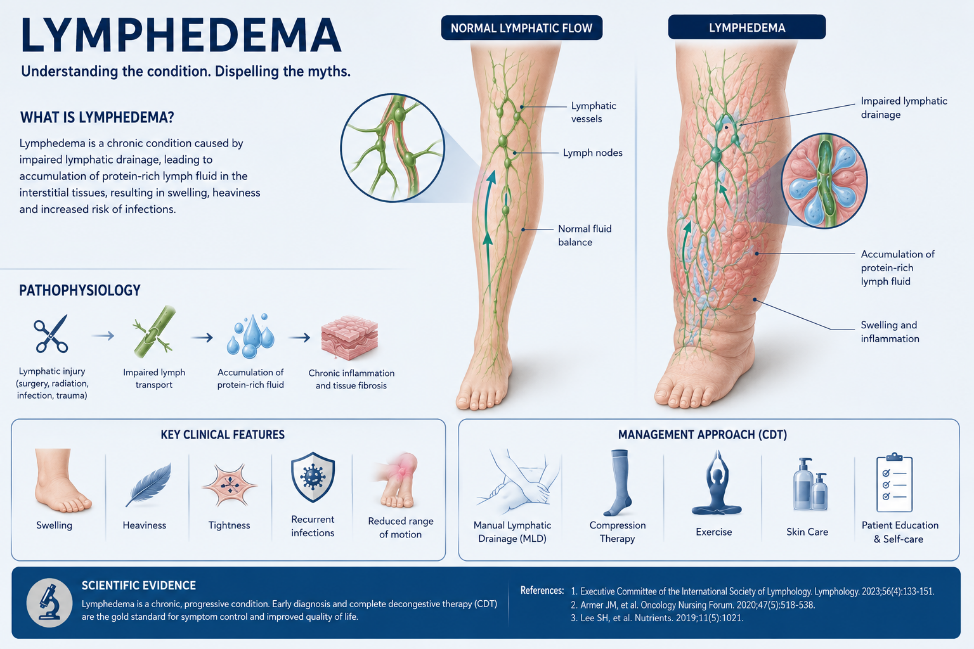
Let’s bust some of the biggest myths.
🚫 Myth: It’s just normal swelling.
✅ Fact: Not all swelling is lymphedema. It occurs when the lymphatic system can’t drain fluid properly, leading to persistent swelling, heaviness, tightness, and discomfort. Unlike temporary swelling, lymphedema is a chronic condition that requires proper management.
Did you know? The International Society of Lymphology classifies lymphedema as a chronic, progressive disease that benefits from early diagnosis and intervention. 1
🚫 Myth: Only breast cancer survivors develop lymphedema.
✅ Fact: While breast cancer treatment is a well-known cause, lymphedema can also occur after other cancer treatments, infections, injuries, surgeries, or due to congenital lymphatic disorders. It can affect anyone, men, women, and even children.2
🚫 Myth: If it doesn’t happen right after surgery, you’re safe.
✅ Fact: Lymphedema can appear months or even years after surgery or radiation therapy. That’s why staying aware of early symptoms and attending regular follow-ups is so important.
🚫 Myth: Exercise makes lymphedema worse.
✅ Fact: Quite the opposite! Safe, guided exercise helps improve lymph flow, maintain flexibility, and support overall health. Activities like walking, swimming, yoga, and light strength training are often encouraged by healthcare professionals.3
🚫 Myth: There’s no treatment, so there’s no point seeking help.
✅ Fact: While there is no permanent cure, lymphedema can be effectively managed with a combination of compression therapy, Manual Lymphatic Drainage (MLD), Complete Decongestive Therapy (CDT), exercise, skin care, and, in selected patients, selenium supplementation under medical supervision. Early diagnosis and appropriate management can reduce swelling, improve limb function, and enhance quality of life.4
🚫 Myth: Compression garments are only for severe cases.
✅ Fact: Compression garments aren’t just for advanced lymphedema, they’re an important part of everyday management. They help prevent fluid build-up, reduce discomfort, and maintain treatment results.5
🚫 Myth: Lymphedema is only a cosmetic issue.
✅ Fact: Lymphedema affects much more than appearance. If left unmanaged, it can lead to pain, limited mobility, recurrent infections, and emotional distress. Early diagnosis and consistent care can help prevent complications.6
🚫 Myth: Drinking less water will reduce swelling.
✅ Fact: Dehydration won’t reduce lymphedema. In fact, staying well-hydrated supports healthy tissues and overall body function.7
🌿 Knowledge is the First Step Toward Better Care
Living with lymphedema doesn’t mean living without hope. The earlier it’s recognized, the better it can be managed. By replacing myths with facts, we empower patients, caregivers, and healthcare professionals to make informed decisions and improve long-term outcomes.
Remember: Awareness isn’t just empowering it can change lives. If you notice persistent swelling, heaviness, or tightness in a limb, don’t ignore it. Early consultation with a qualified healthcare professional or certified lymphedema therapist can make all the difference.
References:
1. The Diagnosis and Treatment of Peripheral Lymphedema: 2023 Consensus Document of The International Society of Lymphology. Lymphology 2023, 56 (4), 133-151.
2. Cheville, A. L.; McLaughlin, S. A.; Glaser, G. E.; Boughey, J. C., Cancer related lymphedema. BMJ 2025, 390, bmj-2024-081351.
3. Han, H. W.; Yang, E. J.; Lee, S.-M., Sodium Selenite Alleviates Breast Cancer-Related Lymphedema Independent of Antioxidant Defense System. Nutrients 2019, 11 (5), 1021.
4. Armer, J. M.; Ostby, P. L.; Ginex, P. K.; Beck, M.; Deng, J.; Fu, M. R.; Lasinski, B. B.; Lockwood, S.; Poage, E.; White, J.; Maloney, C.; Moriarty, K. A.; Vrabel, M.; Morgan, R. L., ONS Guidelines™ for Cancer Treatment-Related Lymphedema. Oncol Nurs Forum 2020, 47 (5), 518-538.
5. Denlinger, C. S.; Sanft, T.; Baker, K. S.; Broderick, G.; Demark-Wahnefried, W.; Friedman, D. L.; Goldman, M.; Hudson, M.; Khakpour, N.; King, A.; Koura, D.; Lally, R. M.; Langbaum, T. S.; McDonough, A. L.; Melisko, M.; Montoya, J. G.; Mooney, K.; Moslehi, J. J.; O’Connor, T.; Overholser, L.; Paskett, E. D.; Peppercorn, J.; Pirl, W.; Rodriguez, M. A.; Ruddy, K. J.; Silverman, P.; Smith, S.; Syrjala, K. L.; Tevaarwerk, A.; Urba, S. G.; Wakabayashi, M. T.; Zee, P.; McMillian, N. R.; Freedman-Cass, D. A., Survivorship, Version 2.2018, NCCN Clinical Practice Guidelines in Oncology. J Natl Compr Canc Netw 2018, 16 (10), 1216-1247.
6. Brenner, E.; Hägerling, R.; Schacht, V.; Schrader, K.; Wilting, J., Definition, Epidemiology and Pathophysiology of Lymphoedema. Cells 2025, 14 (24).
7. Han, H. W.; Yang, E. J.; Lee, S. M., Sodium Selenite Alleviates Breast Cancer-Related Lymphedema Independent of Antioxidant Defense System. Nutrients 2019, 11 (5).
